What Is the DISC Model?
The DISC model is a behavioral framework that explains how people tend to act and communicate, based on two key drivers: pace and priority. It groups behavior into four styles that we describe as: Dominant (D), Inspiring (I), Supportive (S), and Cautious (C).
The DISC Model describes styles of behavior. It does not describe styles of people. People use DISC styles rather than people are DISC styles.
Simple to learn. Deep to apply.
A Simple Explanation of DISC
The DISC model is a practical framework for understanding how people tend to behave and communicate. Because we naturally see situations from our own point of view, it can be difficult to understand why others respond differently. DISC helps explain those differences by providing a clear way to recognize common patterns in behavior.
At its core, the model is based on two key behavioral drives. The first is pace: how quickly and outwardly a person tends to act, speak, and make decisions. The second is priority: whether a person tends to focus first on tasks and results or on people and relationships. These two drives interact to form four predictable patterns of behavior.
These patterns are commonly described as four DISC styles.
The DISC framework is part of the public domain, which means no single organization owns it. As a result, different publishers may use slightly different terms or descriptions for the four styles. While the labels can vary, the underlying behavioral patterns are consistent. DISC is most useful when you focus on patterns of behavior rather than specific terminology.
Here’s how we describe those patterns:
- Dominant (D): Direct, results-focused, focused on quick results and solving problems
- Inspiring (I): Outgoing, enthusiastic, focused on relationships and interaction
- Supportive (S): Steady, patient, focused on cooperation and stability
- Cautious (C): Analytical, detail-oriented, focused on accuracy and quality
These styles are not fixed categories, but reference points that help you interpret behavior more clearly. Most people show a blend of styles, and their behavior can shift depending on the situation.
DISC is simple to learn and often creates quick insight into everyday interactions. At the same time, using it well requires attention to context and develops with experience. DISC is both immediately useful and increasingly valuable over time.
A Deeper Dive into DISC Theory
DISC provides a practical way to make sense of behavioral differences in everyday situations. Instead of relying on assumptions or personal perspective alone, it offers a shared framework for understanding how people tend to act, communicate, and respond to challenges.
Because DISC focuses on observable behavior, it is immediately useful in real interactions. It is especially helpful in leadership, teamwork, and communication. The model helps people recognize differences without judgment, and making it easier to adapt, collaborate, and reduce unnecessary conflict.
Many people find that even a basic understanding of DISC leads to quick improvements in how they interpret and respond to others. At the same time, applying it well requires awareness of context and attention to nuance. The same behavior can have different meanings depending on the situation or the person. and using the model effectively becomes more nuanced with experience.
This balance—quick, practical insight with growing depth—is part of what has made DISC widely used across organizations and personal development settings for many years.
History of DISC
The DISC Model is based largely on the work of psychologist William Moulton Marston, who described patterns of normal human behavior in The Emotions of Normal People (1928). Marston proposed that observable behaviors could be grouped into distinct styles based on how people respond to their environment.
Modern DISC applications retain these core behavioral insights while using updated language and examples to reflect contemporary leadership and workplace contexts. Over time, DISC has become a widely used framework for understanding behavioral differences and communication preferences.
What Does DISC Stand For?
DISC is an acronym for four primary patterns of observable behavior. Here’s how we define those patterns:
- Dominant (D): Direct, results-focused, and focused on results and problem solving
- Inspiring (I): Energetic, enthusiastic, and focused on communication and interaction
- Supportive (S): Steady, patient, and focused on cooperation and stability
- Cautious (C): Analytical, detail-oriented, and focused on accuracy and quality
These styles provide a useful shorthand for recognizing patterns in how people tend to approach both ineraction and task completion. They are not fixed categories, but reference points that help you interpret other people’s behaviors more effectively.
The Two Core Behavioral Drives Behind DISC
Behind these four styles are two underlying drives that shape how behavior shows up in different situations: pace and priority. These are not fixed categories, but lines of continuum. Expressions of these drives fall somewhere along each axis and may shift depending on context.
Pace Drive: How Quickly People Act and Decide
The pace drive reflects how quickly and outwardly a person tends to act, speak, and make decisions.
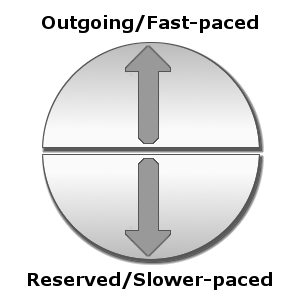 Figure 1: Motor Drive
Faster-paced behavior:
- Moves, speaks, and decides quickly
- Expresses thoughts and emotions openly
Slower-paced behavior:
- Observes, collects information, and analyzes before deciding
- Expresses thoughts and emotions more privately
Most people fall between these extremes, and their pace may vary by situation.
Where this becomes useful—and sometimes challenging—is in interaction. Differences in pace can create friction around urgency, responsiveness, and decision-making. A decision or action that feels efficient to one person may feel rushed or reckless to another, and one that feels thorough to one person may seem too slow or ‘nitpicky’ for another.
Priority Drive: What People Focus on First
The priority drive reflects what a person tends to focus on first when thinking or deciding.
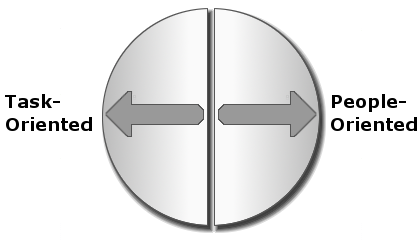
Figure 2: Compass Drive
Task-oriented focus:
- Emphasizes results, logic, and outcomes
- Often frames thoughts as “I think…”
People-oriented focus:
- Emphasizes relationships, emotions, and connection
- Often frames thoughts as “I feel…”
Like pace, this exists on a continuum and can shift by context.
Understanding priority helps you interpret behavior more accurately. For example, directness may reflect a focus on results rather than frustration, while a more relational approach may prioritize connection over speed. Recognizing this difference makes it easier to adapt your communication and avoid misreading intent.
How the Drives Create the Four Styles
The four DISC types emerge from the interaction of pace and priority:
- Outgoing + task-orieneted -> Dominant (D)
- Outgoing + people-oriented -> Inspiring (I)
- Reserved + people-oriented -> Supportive (S)
- Reserved + task-oriented -> Cautious (C)
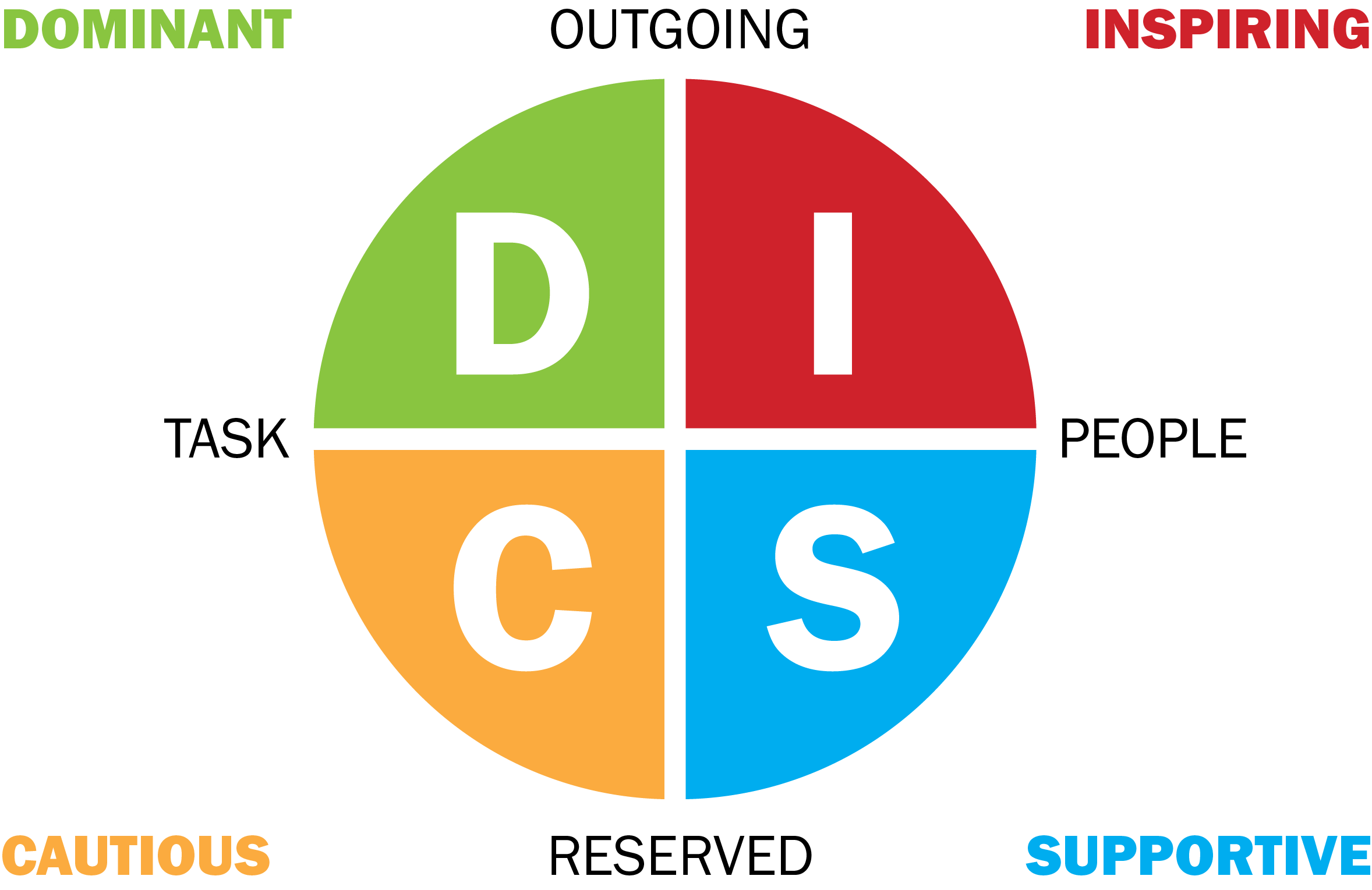
Figure 3: The DISC Model
These styles are best understood as patterns and preferences, not labels and boxes. They provide a starting point for interpreting behavior, while effective use requires attention to context and experience over time.
For a deeper explanation of each style, see our guide to the four DISC styles.
What DISC Measures (and What It Doesn’t)
What DISC Measures: Observable Behavioral Patterns
Even though terms like “DISC personality” and “DISC personality type” are often used, DISC describes patterns of observable behavior rather than personality traits in a clinical sense.
DISC focuses on what you can see: how people act, communicate, make decisions, and respond to their environment. Because these patterns are visible, they can be discussed objectively and, to some degree, adapted as we interact with others.
This is what makes DISC practical. It provides a clear, shared language for understanding behavior and improving interactions.
It also helps you recognize how others may approach situations differently so that you create space for more objective, thoughtful responses instead of quick assumptions.
At the same time, behavior is nuanced and influenced by context. Similar actions can have different underlying causes for different people, and the same person may respond differently depending on the situation. DISC helps you recognize patterns, but it doesn’t replace awareness of context. It gives you a useful starting point for understanding, though.
What DISC Does Not Measure
DISC does not measure values, intelligence, maturity, job skill or ability, work ethic, motivation for a particular task, or mental health.
This distinction helps keep the model grounded.
It reminds you that while behavior is visible, the full picture of a person always includes factors you can’t immediately see.
For example, a direct communication style might reflect confidence in one situation and urgency in another. A more reserved approach might reflect careful thinking or simply a need for more information.
DISC helps you notice these patterns more clearly and objectively, while also encouraging you to stay curious about what may be influencing them.
What DISC Helps You Understand
DISC helps answer questions like:
- Why do some people decide quickly while others take more time?
- Why do some people focus on results first, while others prioritize relationships?
- Why do communication styles sometimes clash—even with good intentions?
- Why do some people get energized by interacting with people while others find it draining?
For many people, this is where DISC becomes immediately helpful. It brings clarity to interactions that previously felt confusing or frustrating.
As you begin applying DISC, you may notice that understanding the patterns is just the first step towards working more effectively with other peopl. Interpreting those patterns in real situations—and choosing how to respond—becomes an ongoing skill that develops with use.
Understanding your DISC profile supports personal growth and leadership development by highlighting yhour natural tendencies so that you can better understand how to adapt your response to fit a situation.
And as you continue to build on that understanding, it becomes easier to recognize not just what people are doing and how your actions affect them, but how to respond in a way that leads to better outcomes.
DISC Styles Are Not Fixed and Rigid
One common misunderstanding is that DISC assessments assign people a single, fixed type or style. In reality:
- Everyone shows all four styles to some degree
- Most people show a blend of at least two styles
- Behavior can shift based on role, environment, and pressure
This flexibility is a strength of DISC. It reflects how people actually behave by adapting to different situations rather than staying fixed in one pattern.
At the same time, this can sometimes make behavior hard to interpret. The same person may respond differently depending on context, and similar behavior can reflect different underlying drivers for different people. Recognizing patterns is an incredibly helpful starting point, and deep understanding in different situations requires judgment.
One challenge of applying DISC shows up in a common way people use DISC in everyday language. For example, people often describe a moment using DISC shorthand by saying, “I got really D in that meeting,” when what they really mean is, “I was direct and forceful in that moment.”
This phrasing can be useful informally, and it can also blur an important distinction.
A single response—especially under pressure or emotion—is not the same as a consistent pattern over time. For example, someone who is frustrated may communicate very directly in the moment. That doesn’t necessarily mean they have a Dominant (D) style or that they are angry. It may simply reflect how they responded in that situation.
DISC is designed to describe patterns that show up consistently across situations, not one-time reactions. Recognizing this helps you avoid drawing quick conclusions based on isolated moments and stereotypes.
By recognizing that DISC style descriptions are tendencies rather than fixed labels, DISC provides a more accurate and practical way to understand behavior. Over time, recognizing patterns—and interpreting them thoughtfully—becomes easier with experience.
DISC Style Blends, Not Boxes
Most people have a primary style along with secondary traits that influence how they behave, so it’s common for more than one DISC type to describe you. You have a DISC profile that represents your blend of DISC traits rather than a single DISC style. This blend creates a unique profile that remains relatively stable over time while still allowing for change and development.
Understanding this can be both reassuring and insightful. It helps explain why you may see yourself in more than one style and why your behavior can shift across different situations.
At the same time, these blends can make it less obvious how to interpret behavior—both in yourself and in others. What appears to be one style in a moment may reflect a combination of influences rather than a single, clear pattern.
As individuals recognize their unique blend of style in their DISC profilce, they often experience moments of self-discovery that support meaningful personal growth and behavior change.
And as that understanding deepens, it becomes easier to move beyond simply identifying styles toward using those insights in a more thoughtful and effective way.
The DISC Assessment
The DISC assessment (sometimes called a disc test) is an instrument designed to measure your behavioral tendencies based on DISC. It involves selecting words or phrases that describe your typical behaviors and preferences, and it’s most helpful when you treat it as an assessment, not a pass–fail test.
The DISC assessment focuses on straightforward choices that reflect your natural tendencies and preferences. A quick free DISC test can give you an initial snapshot, and by answering thoughtfully about your strengths, challenges, and how you prefer to interact with others, you receive a report on your DISC profile (some people call it a personality profile) that can be applied to your relationships with colleagues, friends, and family. Providing quick, instinctive answers to each question helps reveal your natural personality traits, ensuring the results reflect your authentic self.
If you’d like a more thorough understanding of your DISC profile, you can take our full DISC assessment.
Interpreting DISC Assessment Results
When you complete a full DISC assessment, you receive a personalized report that describes your DISC profile in terms of your behavioral style and natural tendencies. The report highlights strengths and areas for development.
The real value of a DISC assessment comes from using the insights you gain from it to understand how your behavioral tendencies impact your daily communication and collaboration with others. The assessment is just the beginning. Applying the insights to adapt your approach in different situations is where meaningful development happens.
Why DISC Is a Practical Tool
DISC is simple enough to understand quickly and deep enough to keep learning from for a lifetime.
Many people find it immediately helpful for making sense of everyday interactions, while also discovering that applying it well becomes a skill that develops with use.
Benefits of Using DISC for Self-Awareness and Communication
DISC is most effective when used to understand behavioral patterns and apply them to everyday interactions. It helps you:
- Increase self-awareness
- Improve communication
- Understand differences in perspective
- Adapt leadership and collaboration styles
Greater self-awareness provides quick clarity about how your natural tendencies influence your decisions, communication, and relationships. This often leads to immediate improvements in how you interact with others.
At the same time, awareness is only the first step. Applying those insights in real situations—and interpreting them accurately—requires judgment and develops with experience.
Improving Teamwork and Reducing Conflict with DISC
Understanding your own style alongside others can quickly reduce misunderstandings. For example, when you interact with a person who has a more dominant style you may benefit from direct, brief communication, and when you interact with someone who has a more supportive style you’ll gett better results using a steady, patient approach.
These adjustments can create immediate wins just by knowing DISC and your style blend. And, remember that context matters. As you work with DISC over time, you’ll gain greater insights and learn more nuanced ways to apply the knowledge.
Knowing your DISC profile quickly helps you recognize patterns that guide communication. Knowing how to apply those patterns effectively in the moment is a skill that develops over time.
By framing behavioral differences as neutral rather than right or wrong, DISC encourages respect, reduces conflict, and supports more productive interactions.
Using DISC to Adapt Leadership and Collaboration Styles
Leaders can use DISC to tailor their approach to individual team members by recognizine when clear, direct communication is best and when support and reassurance are the better path. This flexibility can improve outcomes and strengthen culture.
DISC provides a framework for making these decisions more intentionally. Approaching each situation with curiosity rather than certainty helps you avoid over-simplifying behavior and supports more thoughtful application over time.
Guardrails for Using DISC Responsibly
DISC is most helpful when used as a guide for understanding behavior rather than a shortcut for predicting it.
Use DISC to:
- Improve self-awareness
- Understand differences in perspective
- Adapt communication and leadership approaches
- Build empathy and reduce miscommunication
These uses often create quick wins. They help you make sense of interactions that may have felt confusing and give you a clearer way to respond.
At the same time, recognizing patterns is only the beginning. Applying them well requires judgment.
Do not use DISC to:
- Label or stereotype people
- Predict behavior
- Assign value, capability, or potential
- Replace observation, conversation, or judgment
DISC is a model of behavior, and, like all models, not a perfect representation of reality. It is both helpful and incomplete. It is easy to overapply if used too quickly or too confidently.
The more you work with DISC, the better you become at combining it with observation, dialogue, and feedback. What starts as simple insight becomes more nuanced understanding over time.
Applying DISC with curiosity rather than certainty helps you avoid quick assumptions and leads to better outcomes. This is especially true in complex or repidly changing situations.
Frequently Asked Questions About the DISC Model
What is the DISC model?
The DISC model is a behavioral framework that describes how people tend to act and communicate in different situations. It groups observable behavioral tendencies into four primary styles—Dominant (D), Inspiring (I), Supportive (S), and Cautious (C)—based on differences in pace and priority.
What does DISC stand for?
DISC is an acronym representing four behavioral styles: Dominant (D), Inspiring (I), Supportive (S), and Cautious (C). Each style reflects a pattern of how people tend to approach tasks, relationships, communication, and decision-making.
Is DISC a personality test?
DISC is not a personality test in the clinical sense. It measures observable behavioral tendencies—how people tend to act and communicate—rather than personality traits, intelligence, or psychological conditions.
How is the DISC model used in the workplace?
Organizations often use DISC assessments to improve communication, leadership development, teamwork, and conflict resolution. Understanding behavioral differences helps teams adapt their communication styles and collaborate more effectively, and many practical questions about implementation are covered in our FAQs.
Are DISC styles fixed?
No. Everyone shows all four DISC styles to some degree. Most people have one or two styles that are more natural, but behavior can shift depending on environment, role, and situation.
How I Discovered the Power of the DISC Model
I first encountered the DISC model in the late 1990s, about five years into my corporate career after serving as a submarine engineering officer in the U.S. Navy.
As a young engineer trained to think logically and analytically, I was often frustrated by people around me. I kept wondering why everyone couldn’t just focus on the facts. At one point, I said to a coworker, “I don’t care how you feel — what does the data say?”
He said nothing, and walked away. Then, he avoided me for weeks.
Not long after, a mentor suggested I read a book on the DISC model. I was skeptical, and I agreed to read it. As I worked through it, the descriptions of different behavioral styles began to explain interactions I had never understood—including that moment with my coworker and a few with my wife and kids.
I started to realize people weren’t necessarily being difficult on purpose. They were often responding to different priorities from mine. I tend to focus on results and logic, other people often focus on relationships and how people feel. That shift in awareness immediately changed how I interpreted ohter people’s behavior.
At first, I applied DISC in a simple way: I would notice a pattern and match it to a style. Sometimes that led to quick wins. Other times, I realized I had misread the situation or drawn conclusions too quickly. In some cases, I wasn’t entirely wrong. I had “overread” what was actually happening, though.
Even so, the initial insight made a noticeable difference. I felt less frustrated and more able to navigate interactions that had previously felt confusing.
Over time, my approach became more nuanced. Instead of relying on quick interpretations, I started asking more questions and paying closer attention to context. What began as a simple framework became a more thoughtful way of understanding behavior.
That pattern has continued ever since. The core ideas of the DISC model are straightforward and immediately useful, and using them well is a skill that develops over time.
Summary
The DISC Model provides a simple, practical way to understand behavioral differences by examining how people tend to act (pace) and what they prioritize first (priority).
By recognizing that behavior is relative, situational, and adaptable, DISC gives individuals and teams a clearer way to interpret interactions and navigate differences more effectively.
For many people, this understanding is immediately helpful in making sense of everyday situations. And as they continue to apply it, they often find that their ability to interpret behavior and respond thoughtfully becomes more refined over time.
Explore the DISC Model further:
- What Are the Four DISC Types?
- Why Use the DISC Model?
- What are DISC Behavioral Style Blends?
- What is a DISC Assessment?
Ready to take the next step with DISC?
For many people, the next step is seeing how these patterns show up in their own behavior. A personal DISC assessment can provide a clear starting point and help you begin applying these ideas more directly.
For others, the value becomes even more apparent when applied across a team or organization—creating a shared language that improves communication, alignment, and leadership effectiveness.
Whether you’re exploring this for yourself or looking to apply it with others, you can get started here: